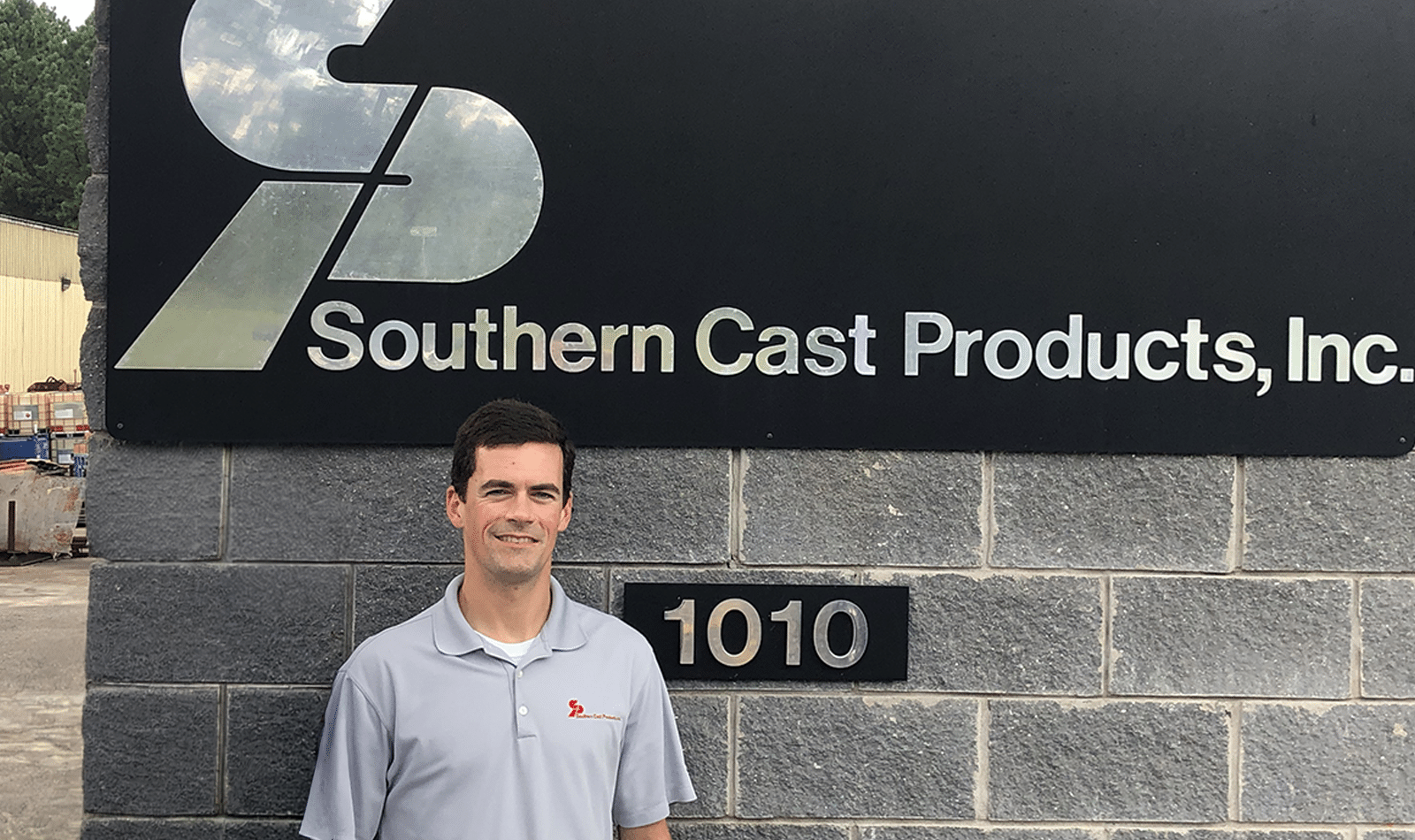
Meet Daniel Wile of Southern Cast Products, Inc.
Daniel Wile spent a year finding a new home for the Mississippi foundry his father opened in 1979. Here’s what finally convinced him.
About the Founder of Southern Cast Products
Fred Wile grew up in Southern California and went to UC Berkeley for engineering. This is where he got his first exposure to manufacturing engineering and found it genuinely interesting. School led to an internship at a foundry in Portland which turned into a job after graduation. That job turned into a rare opportunity when a mentor asked him to help stand up a new foundry in Newton, Mississippi. The opportunity to have a front row seat to building a foundry from the ground up gave this young engineer an education in how a foundry actually works that no amount of time in an established could have matched. A few years after the launch of that foundry, Fred was offered the plant manager position. It was a big assignment for any foundry man, but he took the leap, left Portland and moved to Mississippi.
While he was running that plant, someone on the team decided the boss ought to meet his college professor so he arranged a blind date. The professor’s name was Sissie who would later become Fred’s wife. The fact that people on the team felt comfortable enough to meddle in his plant manager’s personal life tells you a good deal about that plant manager and his philosophy on what makes for a strong work culture. It was the relationships and the people.
The Decision to Stay in Mississippi
After a time, Fred eventually concluded that he loved the South, he loved the foundry work, but he wanted to answer to himself, so that’s what he set out to do. The ambition he set for himself was almost embarrassingly modest: if he could earn the same salary he was already earning and be his own boss while he did it, he’d count himself satisfied. So, that was the plan top to bottom. With Sissie’s support he went and built that dream. 1979 turned out to be a pretty busy year, bringing the Wiles the first of their two children, a daughter, and in the same stretch of months, Fred opened his factory in Meridian. By winter he was pouring castings at Southern Cast Products, Inc.
Fred and Sissie ran SCP for decades. One detail from that era survives in the family retelling of their story that encapsulates Fred’s leadership style. He established one of the plant’s first productivity measures. He shared it with his crew and attached a pretty compelling reward. If the crew hit the goal, Fred would grill them all a steak dinner. Pure and simple. Somewhere in that arrangement is the understanding that targets could be welcomed if they came with a thank-you and that a thank-you and a steak dinner can be the same instrument. Fred also understood that the people who hit the number would like to see and really know the man who set it and he made sure his organization was a place that felt like they could.
Daniel Steps Into Leadership
In 2014, after decades of building and growing the company in this way, Fred moved into the chairman’s seat and his son took over as president. Daniel was an engineer and California-educated, like his father. He’d been working in Savannah, Georgia before he came back home to Mississippi to run the family business. The way he began that transition was very much in line with hallmark of the Wile family’s approach. Daniel took his first meaningful assignment within the first 2 months after he started it didn’t begin in an office. He took the open second shift floor supervisor position.
“I learned a lot that way from the ground up and I this I still earned some respect, too, showing that I’m not afraid of hard work or late hours,” he says. “Earning the respect of your team is essential and I found this approach to be one of the best ways to do that.”
A man who inherits a foundry and elects to start his tenure on the night shift is proving himself to the floor in a way that no memo or mission statement ever could.
The Decision to Sell
Daniel ran Southern Cast for a little over ten years before he began noticing a drift. He saw it in the industry, in the world, and, potentially more uncomfortably, in himself. He began to consider that the next chapter of Southern Cast might be better written by someone else.
In 2025, Daniel and his family decided it was time to sell. They called a broker who came back with several possible candidates. Over the weeks that followed, Daniel, Fred and a few key people worked the list down to four that were worth taking seriously. One of them was Zynik.
Then Daniel did his homework the way a good engineer does his homework, but that homework left him with a problem. He knew what he was looking for in a buyer and all four options looked pretty good, particularly on the people parts that mattered a lot to him and would be an important part of his decision making.
He combed through all of the candidates’ publicly stated philosophies and every mission statement he read said more or less precisely what he wanted to hear. They spoke about partnership and stewardship and people and the long term, but that’s the trouble with mission statements. A paragraph that any company could have written tells you nothing about which of the four to choose, and Daniel wasn’t shopping for a company that could just describe the right philosophy. He was searching for evidence that somebody actually practiced it, and there’s no way to read your way to that understanding. That kind of evidence only reveals itself through interactions with the people you will meet through the course of the courtship.
Preparing to Meet with Buyers
When they were ready to meet the four potential buyers, Daniel and his team made a decision that any owner in Daniel’s position should consider stealing. They declined to host the first face to face meetings. They traveled instead.
“When it was time to meet with the four possible buyers, we decided that we wanted that first meeting to not be on our turf, but on the buyers’,” he says. “We wanted to ensure the conversation stayed focused on them and what they brought to the table versus explaining our operation which we knew would come in time with the right people.”
This was a strategic piece of process design. It allowed Daniel and the team to consider options without disrupting their people, and additionally, it removed the temptation to spend the morning selling his company to the buyers and instead, it forced four separate groups of people to stand in their own buildings and answer a series of much harder questions about who they were and what they actually knew about the foundry business.
Whether they knew it or not, all four groups began their answers before anyone had a chance to say a word. They did this simply by choosing who to send to the very first meeting. Three of the potential buyers sent people from a rung or two down the org chart, which is standard practice and perfectly defensible, since a first meeting is a screen and screening is delegable work.
Meeting with Zynik
But Zynik sent Paul Tuzi, Group CEO of Zynik’s Manufacturing Group, and Adolfo Quiroga, President of Zynik’s Foundry platform, who spent the morning walking Daniel through one of Zynik’s foundries. Daniel noticed the titles and it registered as respect. The use of time on the calendar is one of the simplest and honest things an organization has that reveals its priorities.
Daniel had prepared for the morning the way he prepared for everything else. As thoroughly as possible.
“I studied the website. I read all of the materials. I studied the staff page,” Daniel says. “Our first meeting was going to be with Paul Tuzi and Adolfo Quiroga. I knew what Paul looked like from his website photo so, I knew who I was looking for. We were set to meet at one of Zynik’s other foundries, Niagara Investment Castings. I first noticed Paul in the parking lot. As he walked up, I remember thinking he looked thinner than his website image. And the second thing I noticed was the sign on the building. It said ‘Niagara Investment Castings,’ not ‘Zynik.’ That was interesting.”
Of everything he took in that morning, the sign turned out to be something important, and we’ll come back to it, because it’s the same idea Fred was working with over a grill for his guys forty years earlier.
What moved Daniel further was what Paul did with the time. Daniel had braced himself for a morning with a banker.
“Paul spoke like an operator,” Daniel says. “He walked us through the facility and spoke knowledgeably about the work itself. He knew the work and he knew the people.”
Those two fluencies, the deal and the pour, very rarely live in the same person, and even more rarely in the person at the top.
“After that first meeting with Paul, he became the standard against which I would measure all of the other potential buying groups,” Daniel says.
The second meeting Daniel was able to spend more time with Adolfo Quiroga, President of Zynik’s Foundry Platform, and produced the same impression, that the conversation kept being about a foundry rather than about a deal, which Daniel had already learned was not how these conversations tend to go. Underneath both meetings ran a consistent message about stewardship and long-term ownership, and for him that was going to be an essential load-bearing wall of the decision.
“Just because I’m not the guy to take [Southern Cast] forward, these people [at Southern Cast] deserve to continue to have a future with the jobs they enjoy in the town they love,” he says. “And maybe Zynik would be the company to ensure that.”
Convincing Daniel
He met a good deal of Zynik’s team before it was all over, and he arrived at a conclusion he delivers with a skeptic’s honesty.
“Throughout the process I got to meet a lot of people across Zynik and with every interaction, with everybody I met, I kept thinking, man, these people are either really great at the script, or they actually believe all of this.”
In recounting his company’s history and his journey to eventually selecting Zynik as the buyer, Daniel never mistakes Zynik’s mission for naivete. He shares that the process of selling a business is a business transaction, and naturally, it had tension points, negotiation, and real pressures.
“There were some hard conversations, naturally, but at no time did I feel disrespected or treated unfairly. The Zynik team was always professional and at the end of the day, I am happy with the outcome and am hopeful for a great future for Southern Cast and I think that’s all a seller can ask for.”
The Zynik Difference
Which brings us back around to the sign, and to what Zynik actually believes, which is not just sentiment but a thesis about how money gets made. Treat people well and they will treat your customers well, and customers who are treated well will pay you well and keep paying you. That’s the flywheel. And we recognize the name on a foundry is essential to the people in that foundry. So we treat it as an asset. It’s what a customer trusts, what a town knows, who a molder tells his kid he works for, and painting our logo over it would destroy value we just paid for.
Fred Wile grilling steaks for a crew that hit its target understood the importance of team identity and name and community and this whole mechanism decades before. Now we get to honor that same philosophy into the next era.
Daniel just signed with us a week ago and is the first person to point out that he’s probably still in the honeymoon phase, but he’s happy with the early actions. First, Adolfo wanted to host a welcome luncheon right away.
“Something that struck me was that when Adolfo came down, he wanted a Southern Cast branded shirt to wear on that first day to show how much he valued our guys and our company,” Daniel says.
Adolfo has been on the floor regularly ever since.
“He’s spent a lot of time already with the guys on the floor and he’s earning their respect,” Daniel says. “He knows what he’s talking about and the guys see that. He’s also not afraid to say what needs to be said. He’s confidently decisive, honest and transparent in a way that the guys are responding to. When he sees something needs work, he calls it out. He doesn’t call out the people, he calls out what needs to change in the process to the benefit of all.”
Elsewhere in the company, other Zynik people have already moved to support with transitions to new benefits plans and a new 401(k), which reads as genuine care and is also simply how you hold onto a team doing good work.
“Selling a family business is a pretty unique experience,” Daniel says.
“You’re not just selling an asset, you’re selling a history and a legacy that was built by hands you know and love. I know we’re still in the honeymoon phase, but I like what I’m seeing. It’s been refreshing to realize that it actually is possible to partner with a buying group in a specific way,” Daniel says.
“What I would tell a business owner who is where I was a year ago, just beginning this journey and considering Zynik is this: hear them out. This is not the stereotypical acquisition company that I honestly thought was the only way.
“I truly believe that these are the folks who are going to honor and protect the people and that they are going to be good stewards of my family’s legacy. I truly believe our company is in better hands to take them into the next phase of the journey.”
We intend to prove Daniel right.